
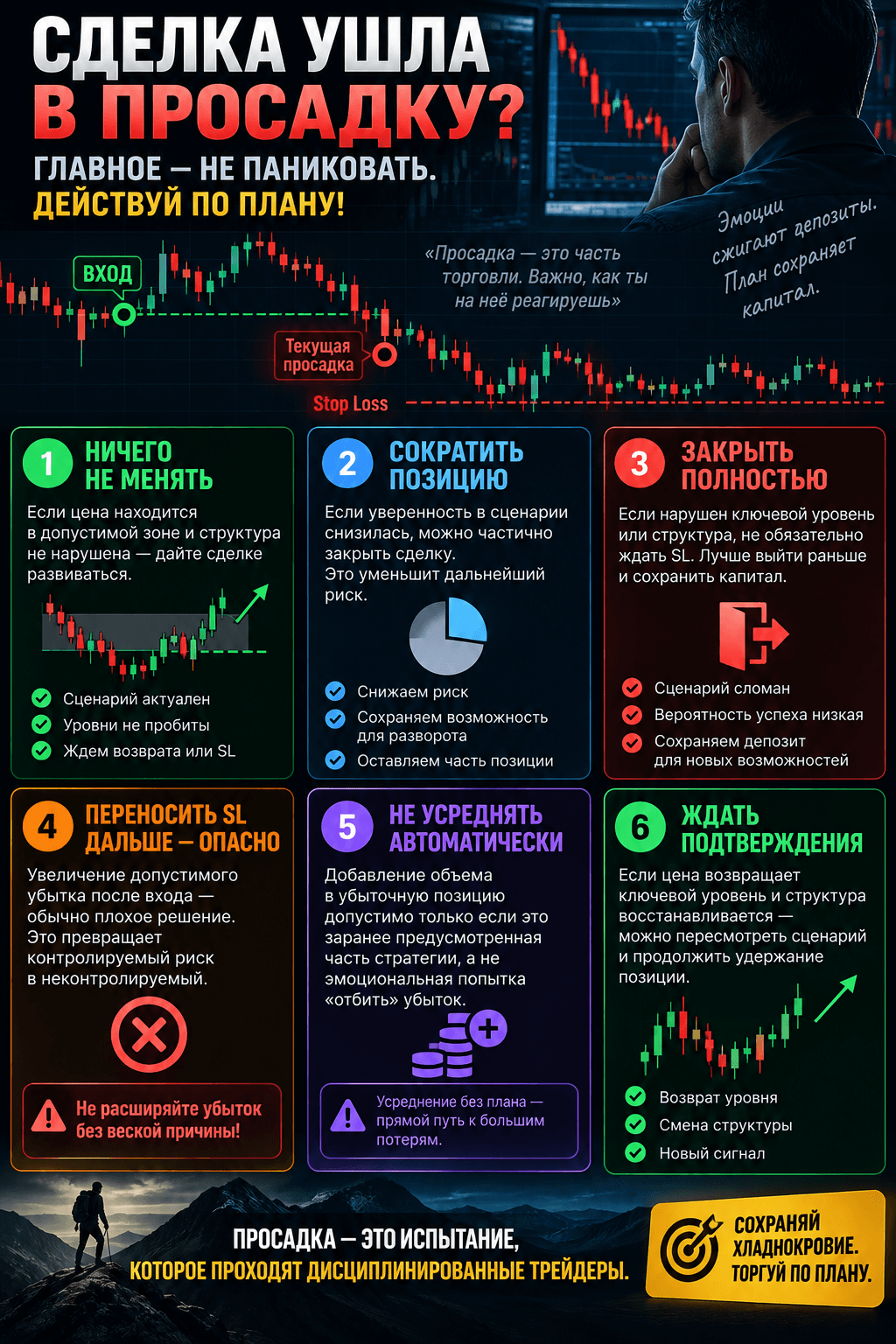
The most expensive mistake with a losing position is the urge to immediately do something about it. As long as price stays within the acceptable zone, being in the red isn't new information - it's just normal market behavior within the risk you already accepted. For me, the key thing here is separating the fact of a drawdown from the fact of a broken scenario.
First I check the scenario, not the account
I look not at the size of the loss, but at why the trade was opened in the first place. There was a level, there was a structure, there was an expected direction. If all of that still holds, and price is simply moving around inside the range allotted before the stop, no decision needs to be made.
But if the key level is broken and the structure has shifted, the trade is no longer what it was at entry. At that point, debating "let's wait a bit more" is pointless - the idea is gone, all that's left is open risk.
So for me a position only has two states: the idea is alive, or the idea is broken. Every action branches off from that fork, not from how big the loss shows on screen.
Does a drawdown necessarily mean the entry was wrong?
No, a drawdown within pre-calculated risk is a normal part of the trade - it only becomes a mistake if the scenario itself breaks down.
How do you know the idea is broken?
By the break of the key level and the shift in structure the trade was built on - not by how deep the loss is.
Do you have to ride the trade down to the stop no matter what?
No. If the level and structure are broken, there's no need to wait for the stop - at that point it isn't protecting anything anyway.
Four possible actions
Do nothing - when price is within the acceptable zone and the structure is intact. The trade simply plays out: it either turns back in the expected direction or hits the planned stop.
Reduce the position - when the probability of the scenario has dropped, but there's no clear break yet. A partial close cuts further risk while leaving some size on in case the idea still plays out.
Close fully - when the key level or structure has broken. Here I don't wait for the stop to formally trigger.
Move the stop further away - usually the worst option of all. Widening the acceptable loss after entry means a calculated risk gets swapped for an unknown one, and the exit decision gets pushed to later, when it'll be even harder to think clearly.
When do you reduce a position, and when do you close it fully?
I reduce when the scenario has weakened but the level is holding; I close fully once the level and structure have already broken.
Is it ever okay to move a stop-loss?
Moving it to reduce risk - yes. Moving it to increase the loss after entry - almost never.
What if the stop is placed too tight and gets clipped by noise?
That's a question about how the stop was sized before entry, not about moving it afterward - fix the position size and stop placement on the next trade.
Averaging down and reconsidering the idea
I only consider it acceptable to add to a losing position when it's written into the strategy in advance - with known add-on levels, total risk, and a point of invalidation. Anything else is just an attempt to get back to breakeven, and it only makes the problem bigger, not smaller.
A reversal is a different story. If price reclaims the key level and the structure shifts in my favor, the original scenario can be reconsidered. But only after confirmation - not the moment you simply want to believe the worst is over.
I keep the main principle short: the action is defined by the state of the idea, not the state of the account. A drawdown is a consequence, not a signal.
Frequently asked questions
Is it okay to average down a losing position?
Only if the add-on was planned before entry with known levels and total risk - otherwise it's an emotional decision.
What counts as confirmation of a reversal in your favor?
Reclaiming the key level and a shift in structure - not a single candle in the right direction.
Why not just wait for price to come back?
Because without a loss limit, waiting has no end, and one case like that can wipe out the result of an entire series of normal trades.
What determines the decision on a trade that's gone into drawdown?