
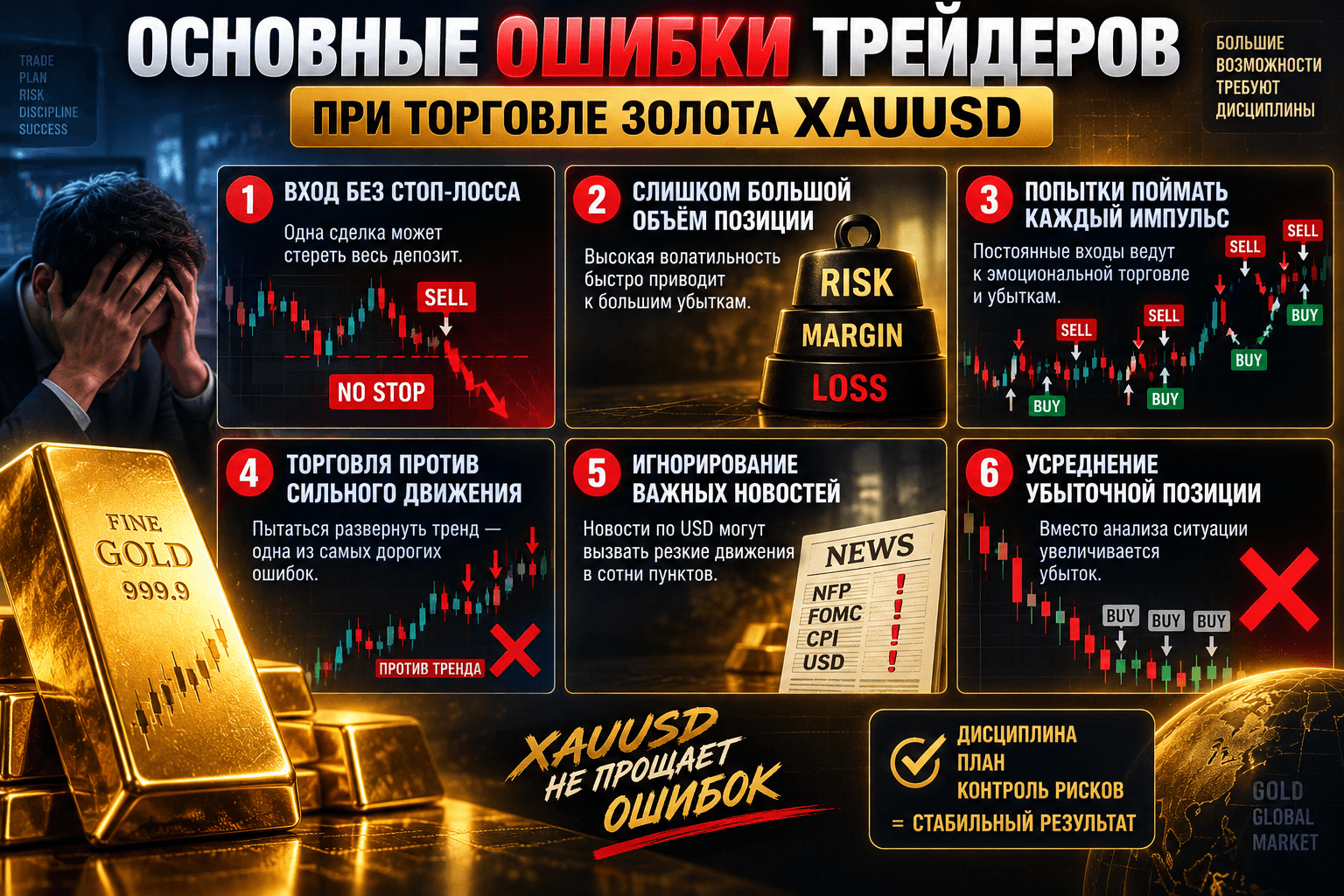
Gold doesn't forgive chaotic trading. The instrument delivers strong moves, but it makes you pay for them with range: what looks like noise on other pairs becomes a full-blown move against your position here. Here are the mistakes I run into most often.
Stop-loss and position size
Entering XAUUSD without a stop isn't up for debate as far as I'm concerned. Price here can move against an entry by a distance that looks impossible on the chart, and it can do it in minutes. Without an exit level set in advance, the decision gets made in a panic - and panic decisions are the most expensive kind on gold.
The other half of the same problem is position size. When the lot size is picked to hit a target profit rather than to match the actual candle range, even a directionally correct entry gets wiped out by an ordinary pullback. I calculate size based on the distance to the stop, never the other way around.
Why does the stop-loss matter more on gold than on other instruments?
Because of volatility: XAUUSD can run against a position by distances that a normal account without protection simply won't survive.
How do you size a position on XAUUSD?
Pick the stop level from the chart first, then calculate size from the acceptable loss - never the other way around.
Is it okay to move the stop if price gets close to it?
Pushing the stop further away turns a limited risk into an unlimited one, and that's exactly how most big losses start.
Impulses, counter-trend trades, and news
Trying to catch every impulse is a classic mistake on a volatile instrument. Gold produces plenty of moves per day, and it feels like every one of them is playable. In practice you end up with a string of random entries with no single logic behind them, and commissions plus spread eat up whatever the lucky trades made.
Trading against a strong move looks tempting: price has run far, a pullback seems inevitable. But a strong move on gold often lasts longer than an account can absorb, and fading it against the trend carries risk completely out of proportion with trading in the direction of the move.
Then there's news. Gold reacts to macro data and central bank statements far more sharply than to any chart pattern. Entering a position without knowing what's due out in the next half hour means handing the outcome of the trade over to chance.
Should you trade gold during news releases?
Spreads widen and slippage increases during news, so entering at those moments calls for a reduced position size in advance - or skipping the trade entirely.
Why is trading against a strong move on XAUUSD risky?
Gold trends tend to run longer than most people expect, and a counter-trend position needs a stop that almost nobody actually respects.
How many trades a day is normal on gold?
The number of trades doesn't matter - having a reason for each one does: entries taken "so as not to miss out" are a different animal from trading by the rules.
Averaging and the "just wait it out" myth
The biggest mistake I see is the belief that a gold position can always be waited out. The logic goes: it's a long-established asset, its value isn't going anywhere, it'll come back eventually. But an account doesn't get closed at the metal's fair value - it gets closed on margin, and the position usually doesn't survive long enough for the comeback.
Averaging a losing position makes this worse. Every add-on increases size at the exact moment the market has already shown the entry was wrong. The losing position gets bigger right when it should have been heading toward zero.
Solid returns on XAUUSD don't come from boldness - they come from keeping losses capped in size from the start. Discipline here isn't a nice-to-have on top of a strategy; it's part of the strategy.
Why shouldn't you average a losing gold position?
Averaging increases size against a move that's already confirmed itself, and the liquidation price gets closer faster than any potential recovery.
Is it true that gold always bounces back eventually?
The metal's long-term trajectory has nothing to do with any single trade: a margined position gets closed by the broker's requirements long before any recovery happens.
What should you do if a position without a stop has gone into a loss?
The decision should be based on the size of the risk, not on hope: the longer a loss sits without a plan, the more expensive the eventual exit becomes.
What most often causes big losses on XAUUSD?