
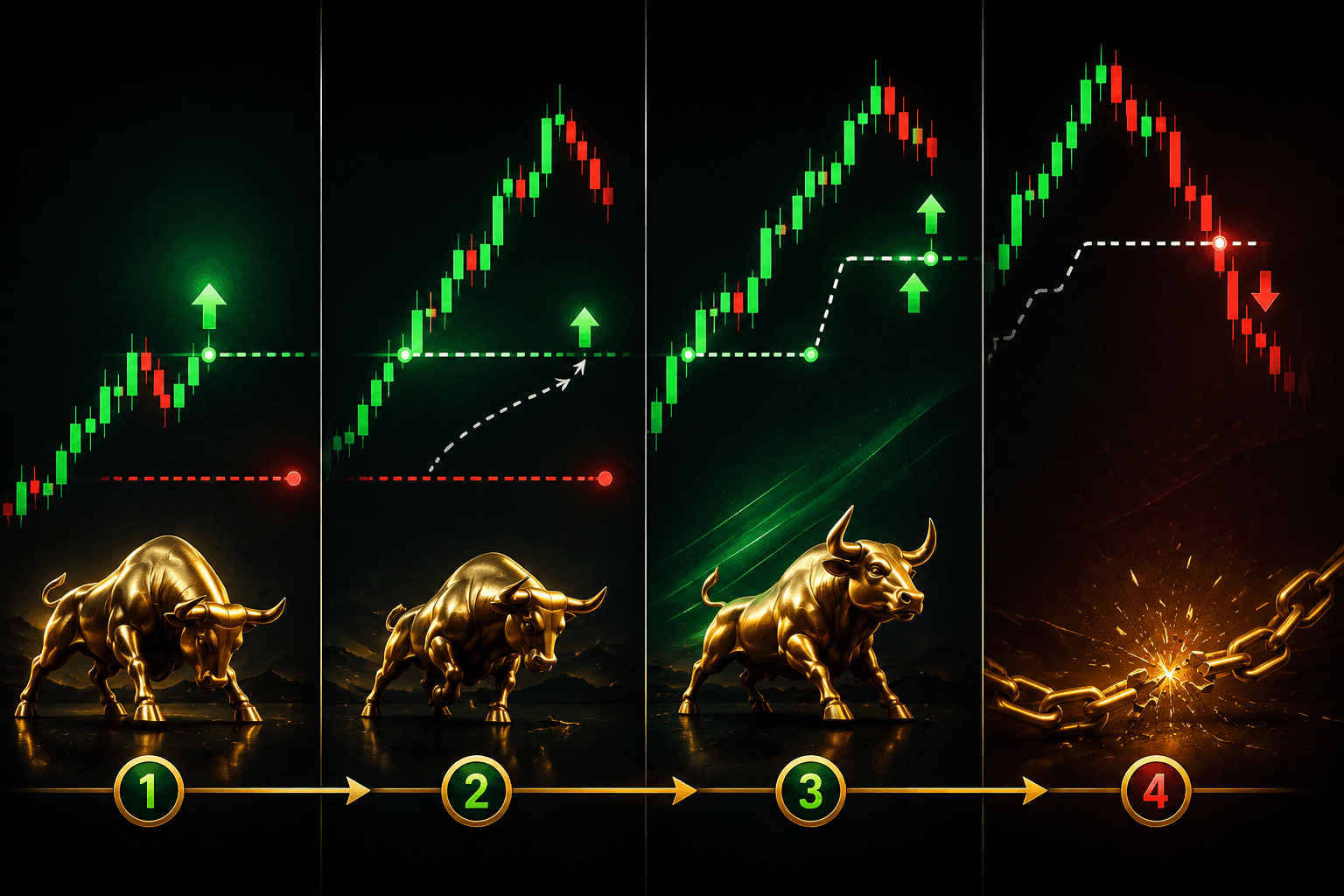
A trailing stop is a stop-loss that automatically moves along with the price while a trade is going your way. You set a trailing distance, and the stop follows every new price extreme, keeping that same gap. As soon as the price reverses by the set distance, the position closes.
Why it matters
The main problem with a winning trade isn't the entry - it's deciding where to exit. While the move is still running, traders rarely adjust their stop manually: either they're not watching the chart, or they're reluctant to close early. Trailing removes that decision: the rule is defined once as a number and then runs on its own.
The second thing it gives you is locking in ground already covered. Once the price has moved far enough, the stop sits above your entry point, and the trade can no longer turn into a loss under any scenario. From there, the only question is how much of the move you give back on the pullback.
An important mechanical detail: a trailing stop only moves in one direction. In a long position, it rises with new highs and stays put when the price pulls back. It never moves down, so there's no way to retroactively widen your risk.
What it looks like on a chart
Imagine a long position with a 100-point trailing distance. The price moves up 300 points - the stop sits at 200 points of profit. Then a 100-point pullback happens, and the position closes. Net result: you captured not the entire move, but the move minus the trailing distance.
This shows what you're paying for the automation. The trailing distance always means giving back part of the move to the market. It can't be zero, because price doesn't move in a straight line - every trend contains corrections, and the stop has to sit beyond them.
In practice, it makes more sense to base the distance not on a round number but on the typical candle range for your timeframe. If the average candle spans 80 points, a 30-point trailing distance will close the trade on the very first correction, telling you nothing about the trend.
Where it stops working
In a sideways market, a trailing stop loses its purpose. Price moves within a range, the stop creeps up to a local high, and then gets triggered on the move back toward the lower boundary. A series of such exits with tiny profits or at breakeven eats up more than it earns.
The second situation is gaps and sharp spikes. A stop at a given level doesn't guarantee execution at that level: the market opens lower, and you get whatever price is available. This happens more often in thin markets and around news releases.
And third: a trailing stop doesn't know where your idea ends. If you entered the trade aiming for a specific target, an automatic stop might knock you out a couple of points short of it - or let you overstay the point where the trade's original logic already stopped making sense. It manages distance, not logic.
Common questions
How is a trailing stop different from a regular stop-loss?
A regular stop sits at a fixed level until cancelled, while a trailing stop follows the price toward profit on its own and never moves back.
What trailing distance should I use?
One that's larger than the typical pullback range on your timeframe, otherwise the stop will trigger on noise instead of an actual reversal.
Can I set a trailing stop right at entry?
Yes, but until the price has moved by the trailing distance, it doesn't move at all and simply acts as a regular stop at the initial level.
Does a trailing stop work when the terminal is closed?
It depends on the broker: a server-side trailing stop always works, while a terminal-side one is calculated on your end and stops updating once the program is closed.
Does a trailing stop protect against a gap?
No. It sets the exit level, but execution happens at the first available price, which can be noticeably worse after a gap.
What happens to a trailing stop on a long position if the price pulls back down?