
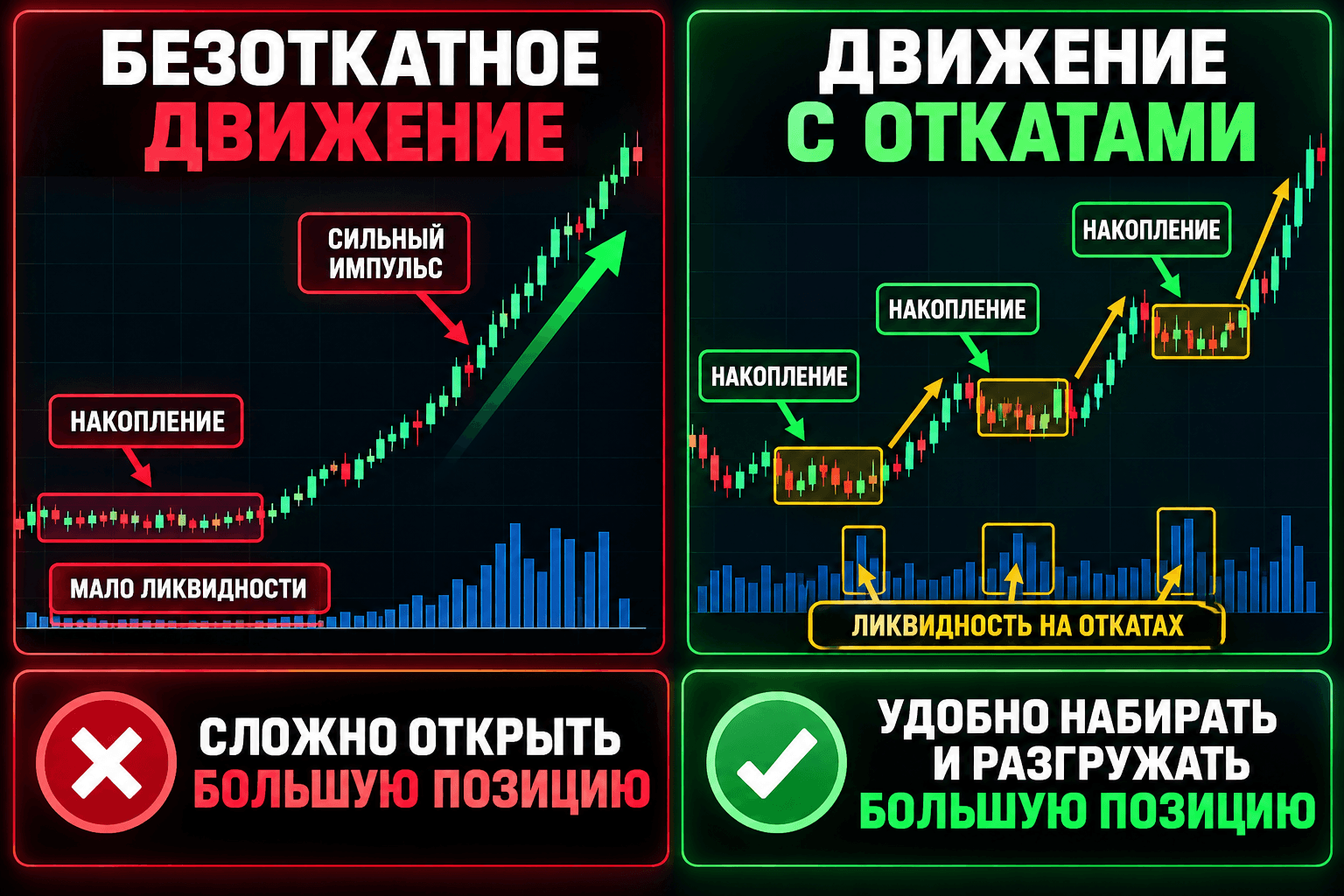
The question sounds simple: which move is more profitable for a big player to earn on - a pullback-free one or one that keeps swinging back and forth. The answer depends on which phase they're currently in, and that's exactly what changes how you should read the chart.
Why the pullback matters more than the impulse
You can't buy a large position with a single order. You need someone on the other side of the order book, and in a pullback-free rally there are few sellers: price keeps climbing, and each next lot costs more than the last. For me this is the key point: a big player doesn't pay commission, they pay slippage.
A pullback solves this problem. When price pulls back, the market gets visits from those taking profit and those selling in anticipation of a reversal. They're the ones who supply the volume needed for accumulation.
That's why a range with moves into both directions is often more useful for a large player than a beautiful straight line on the chart. In a range they build their position at an average price, not at the top.
Common questions about building a position
Why can't a large volume be accumulated in a pullback-free rally?
Because there are few counter-sellers in it, and every subsequent purchase moves the price against the buyer themselves.
What does a pullback give a large player?
A counterparty: those taking profit and those selling into the reversal, which is exactly what supplies the volume for accumulation.
Does any range mean a position is being built?
No. A range can also be just ordinary fading interest, where volume drops along with the amplitude.
When a pullback-free move becomes profitable
Once the position is already built, the picture flips. Now what's needed isn't a counterparty for entry, but a move that realizes the accumulated potential. A pullback-free impulse does this quickly and without unnecessary nerves.
During such an impulse, a large player more often isn't buying but gradually unloading: the rally attracts retail demand, giving them someone to sell to. From the outside it looks like a confident rally, even though the opposite process is happening underneath.
| Type of move | Who it suits | What it provides |
|---|---|---|
| With pullbacks | Someone accumulating | Liquidity and a good average price |
| Pullback-free | Someone already in position | Fast realization and demand for unloading |
Common questions about distribution
Does a large player sell on the way down or on the way up?
Big volume gets unloaded where there are buyers, meaning more often during an impulsive rally rather than during a sell-off.
How do you tell accumulation phase from distribution phase?
By the link between volume and range: accumulation happens with high volume and little price movement, distribution happens with fast movement on rising demand.
Does a steady rally without pullbacks mean the move will end soon?
Not by itself, but the absence of pauses means there's nowhere in it to build a new large position.
What this means for reading the chart
I don't look at a move as "strong" or "weak" but as convenient or inconvenient for accumulation. If price climbs in jerks, with pullbacks and elevated volume in the stopping zones, these are conditions in which big volume could have been building up.
But if the move runs along a straight line and every pullback gets bought up within the same candle, there's nowhere and no one to accumulate there. That stretch is better read as the working-out of an already-built position.
The bottom line is this: a large player's profit is formed not at the moment of the impulse, but before it - in a properly built position and in having the liquidity on hand to sell it afterward.
Why does a large player need pullbacks?