
Pairs trading doesn't start with a chart, it starts with picking two instruments. I need a stable historical relationship between them, along with regular divergences: if a pair always moves in sync there's nothing to trade, and if the relationship breaks down for months, there's nothing to expect a reversion to the mean from.
Correlation and spread aren't the same thing
The correlation coefficient only shows that two instruments have tended to move in the same direction more often than not. It says nothing about how far apart they can drift or how fast they snap back.
What matters more to me is whether the spread between the instruments can be described statistically - where its normal range sits and where a deviation counts as unusual. If the spread wanders without a stable mean, a pretty correlation figure by itself doesn't justify a trade.
That's where my filter comes from: first the economic logic of the relationship, then the behavior of the spread, and only then the correlation number as confirmation.
Which pairs I look at on Forex
The currency market is convenient because the link between instruments is often visible right in their makeup: a shared base or quote currency already gives you a basis for comparison.
| Pairing | Logic of the relationship |
|---|---|
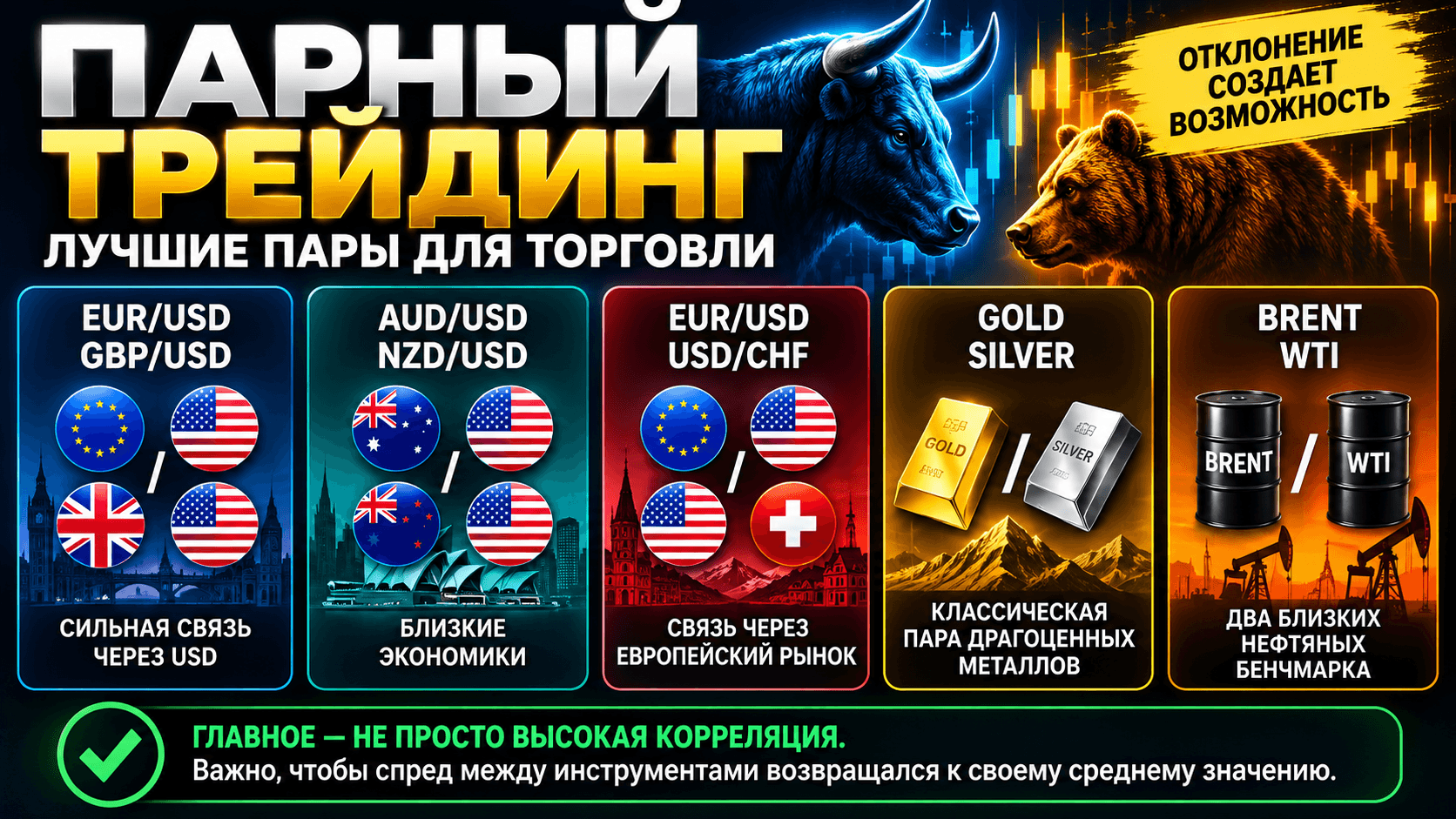
| EUR/USD - GBP/USD | Strong link through USD and the European economy |
| AUD/USD - NZD/USD | Very closely tied economies of Australia and New Zealand |
| EUR/USD - USD/CHF | Linked through the European market, but direction is inverted |
| AUD/USD - AUD/JPY | Shared AUD, but different sensitivity to JPY and risk sentiment |
| GBP/USD - EUR/GBP | Shared GBP, convenient for viewing the pound's relative strength |
I consider EUR/USD and GBP/USD the clearest pairing to start with: both pairs are quoted against the dollar, and both are tied to the European economy. AUD/USD and NZD/USD move even more tightly together, since the economies are neighboring and similar.
EUR/USD - USD/CHF stands apart: there is a link, but the dollar sits on opposite sides in these pairs, so the divergence reads as a mirror image. AUD/USD - AUD/JPY is interesting because the currency is shared, yet the reaction to risk and to the yen differs, and that difference is exactly what creates the spread.
Common questions about picking pairs
Is high correlation enough to trade a pair?
No. Correlation tells you the moves are in sync, but a trade needs a spread with a clear mean and a measurable deviation from it.
Why do pairs traders pick instruments with a shared currency?
A shared currency sets up an economic basis for the link, so divergence is more likely explained by the other factors rather than by chance.
Can you use pairs with inverse correlation?
Yes, EUR/USD and USD/CHF are exactly that case: the link runs through the European market, but the direction of movement is opposite.
Metals, oil, and non-standard pairings
Outside of Forex, the pairing I find most interesting is Gold - Silver, meaning XAU/USD against XAG/USD. It's a classic way to look at the relative value of precious metals, and the divergences there happen regularly.
Brent and WTI are two closely related oil benchmarks. The logic of the link is transparent - both reflect the price of oil - and the spread between them has a life of its own.
Gold futures against spot formally give a very tight relationship, but I don't consider that pairs trading in the usual sense. It's closer to an arbitrage setup with its own execution requirements.
AUD/USD - Gold gets mentioned a lot, and the historical link genuinely exists. But it's noticeably less stable and depends heavily on macro conditions, so I treat it more cautiously than pairings within a single asset class.
Common questions about instruments
Why is the gold-silver pairing more reliable than gold - AUD/USD?
Metals belong to the same asset class, so their link holds up more steadily, while gold's link to the Aussie depends on macro conditions.
Why aren't gold futures and spot considered a regular pair?
The link there is too tight and technical by nature - it's closer to arbitrage on the quote difference than to trading a spread deviation.
Are Brent and WTI suitable for a beginner in pairs trading?
Their relationship is about as simple as it gets - both instruments reflect the price of oil, so the spread reads without complicated assumptions.
What matters most when picking a pair for pairs trading?