
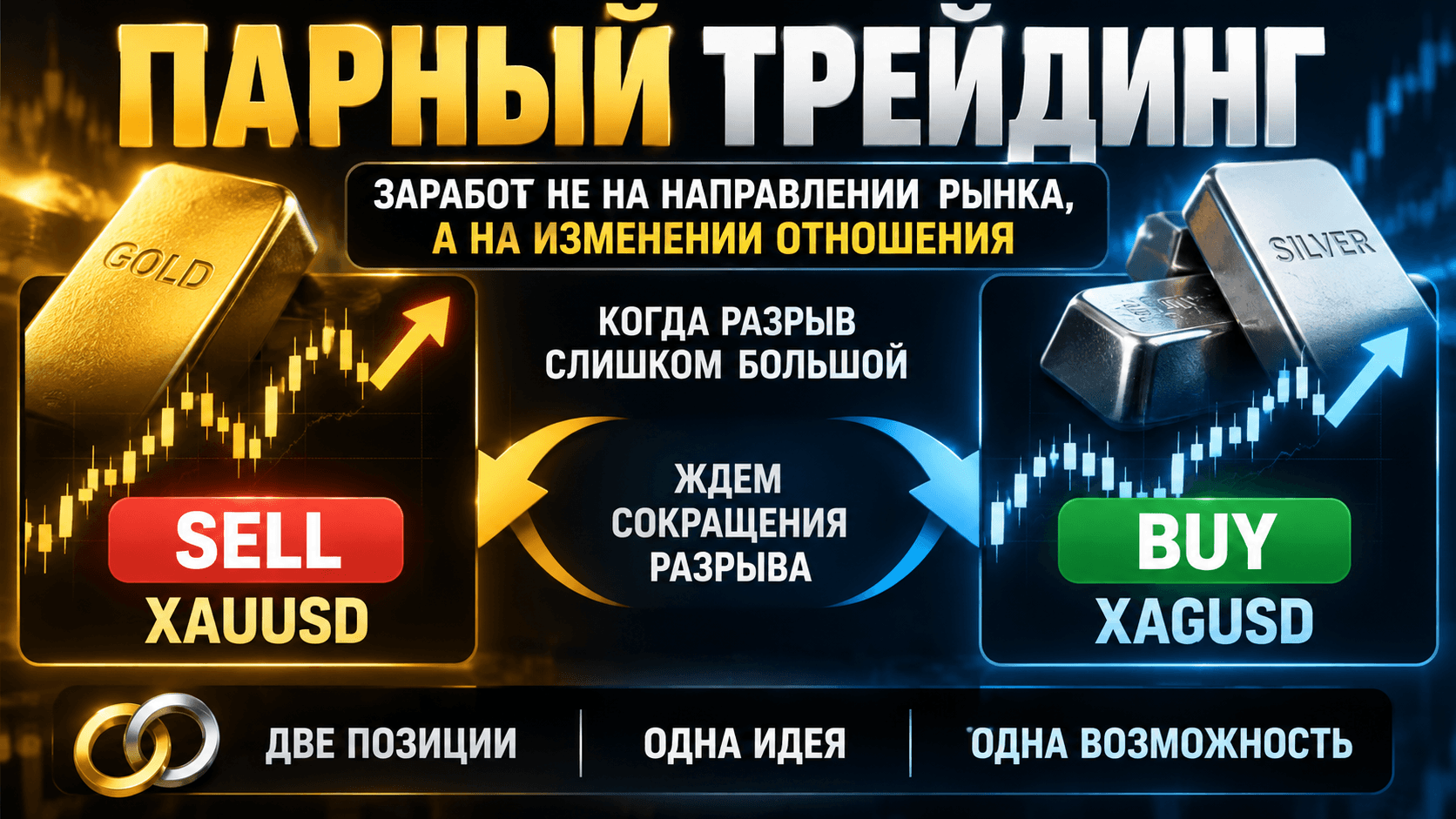
When I look at two instruments that usually move together, what interests me isn't where they're heading, but how far apart they've drifted from each other. That's the whole idea behind pairs trading.
What a pairs trade actually is
The idea is that you open a position in two related instruments at the same time, but in opposite directions. One gets sold, the other gets bought. From there, all the attention shifts to the gap between them.
Take gold and silver. They've moved in sync for years, and when gold suddenly pulls ahead of silver noticeably, a gap opens up. The logic of the trade is simple: sell whatever's run too far ahead, buy whatever's lagging, and profit as the gap closes.
The money here comes from relative value. If the whole metals market rallies, I'll be up on the long leg and down on the short leg, but the outcome still hinges on how the ratio between the two legs has shifted.
Common questions about the core idea
How is a pairs trade different from a regular directional trade?
In a regular trade, the outcome depends on where the price of an instrument goes. In a pairs trade, it depends on how the gap between two instruments changes.
Do both legs have to be the same size?
Position sizes are set so the dollar impact of a move is comparable on each leg - otherwise one side outweighs the other and the trade turns directional.
Which markets is pairs trading used in?
It's used with stocks, currencies, commodities, and cryptocurrencies - anywhere there are instruments with a stable relationship to each other.
Where the link between instruments comes from
The link exists wherever assets share a common driver. Gold and silver are both precious metals, shaped by similar forces. Two stocks from the same sector react to the same news. Currencies of commodity-driven economies depend on the same commodity cycle.
As long as that shared foundation holds, the instruments move alike, and deviations look temporary. The trouble starts when the foundation shifts: one company gets its own story, one metal picks up its own industrial demand. At that point, the gap stops being noise and becomes the new normal.
That's exactly why I don't treat correlation as a guarantee. It describes what already happened and promises nothing about what comes next.
Common questions about risk
Can a pairs trade lose money on both legs at once?
Yes, if the link between the instruments has broken down - the one you bought keeps lagging, and the one you sold keeps climbing.
Does strong correlation mean the gap is bound to close?
No. Correlation just describes how the two moved together in the past and doesn't obligate the ratio to return to its old level.
Is a pairs trade risk-free since the positions offset each other?
No. It cuts your exposure to overall market direction, but the risk that the relationship between the instruments itself breaks down remains fully in place.
What you pay for being market-neutral
| Approach | What it offers | What it costs you |
|---|---|---|
| Directional trade | A straight bet on price movement | Full market risk |
| Pairs trade | Less dependence on the broad market | Risk of the relationship breaking down, doubled costs |
Two positions instead of one mean doubled costs on entry and carry. On top of that, pairs setups often play out slowly, and time works against your account if the gap doesn't close.
That's why, for me, the key to pairs trading isn't spotting the gap - it's deciding in advance how wide it has to get before I admit the link between the instruments no longer holds.
What does a pairs trade actually profit from?