
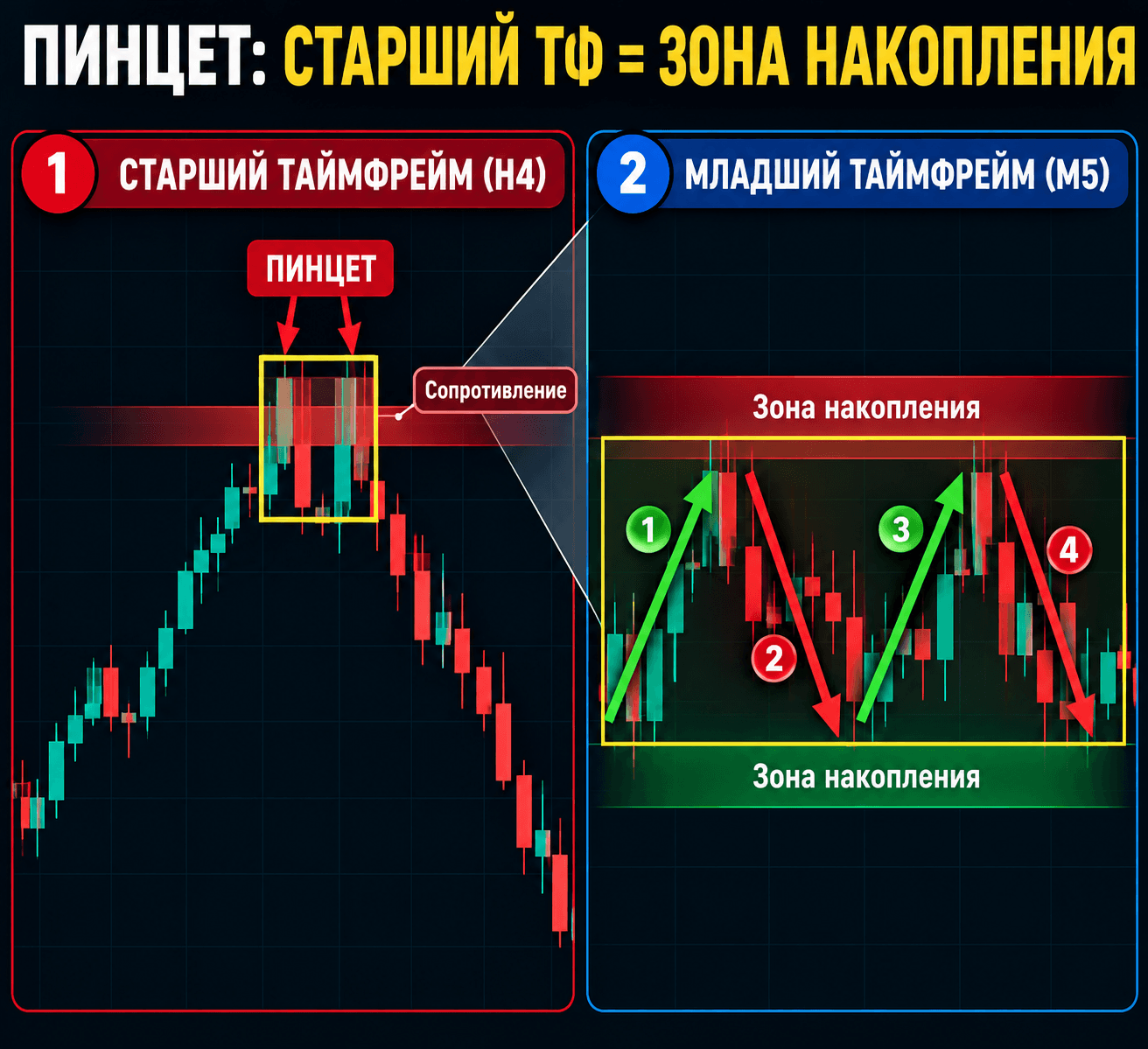
"Tweezer" is often read as a ready-made signal: you see two candles with matching wicks and position against the move. I look at this pattern differently - for me it's not about a reversal, it's about buyers and sellers clashing at the same price twice.
What two candles with matching extremes actually show
Close highs on two neighboring candles mean exactly one thing: price approached a level, got rejected, came back, and got rejected again. Same with the lows, just with the roles reversed.
This is a fight, not its outcome. If you only look at the higher timeframe, this whole fight is compressed into two candles and looks like a finished signal. In reality the result hasn't been decided yet.
That's exactly why I don't treat the "Tweezer" as an entry point. For me it's a marker on the chart: worth a closer look here, because something is happening.
Common questions about reading the pattern
How closely do the candles' extremes need to match?
A perfect match isn't required, what matters is that price stopped at roughly the same level both times instead of pushing further.
Does the "Tweezer" only work at tops and bottoms?
No, it can appear anywhere on the chart, and more often it's just a pause within a move rather than a trend break.
Why does the pattern fail to play out so often?
Because it's treated as a standalone signal, even though it only shows the fact of a clash, not which side won.
Marking the boundaries and switching to a lower timeframe
The first thing I do when I spot such a pair of candles is mark the boundaries by their extremes. The upper border by the highs, the lower border by the lows of those same candles. That gives a rectangle, and the whole story will play out inside it.
Then I switch to a lower timeframe and look at the price structure inside the zone. That's where you see what's hidden inside the candle body on the higher timeframe: where price lingers, where the wicks stretch, and which side the pressure is stronger on.
This zone can last longer than expected. Accumulation doesn't have to resolve within the next couple of candles, and trying to guess the breakout in advance usually ends with an entry in the middle of the range.
Common questions about mapping the zone
Which lower timeframe should I switch to?
One where you can see at least a few dozen candles inside the zone, otherwise you won't be able to make out the structure.
How long does such an accumulation zone last?
It's unknown in advance, and that's normal: the whole point of the approach is to wait for the breakout, not predict its timing.
What counts as a signal inside the range?
I don't look for signals inside the range, I'm only interested in how price behaves at the borders and the moment of breakout.
Breaking out of the range and cancelling the scenario
Direction is shown by the breakout. A break of the upper border signals an advantage for buyers, a break of the lower border signals an advantage for sellers. Before that, neither side has the upper hand.
I wait not for a touch of the border, but for a close beyond it followed by a retest of the broken side. The retest is exactly what answers the question of whether the former border has become support/resistance for price, or was just pierced on emotion.
A move back inside the range after the breakout forces a rethink of the whole setup. It's not a reason to flip immediately, it's a reason to admit the structure hasn't resolved yet and go back to watching.
Common questions about breaking out of the zone
What's the difference between a confirmed close and a simple break of the border?
A confirmed close means the candle closes beyond the border, while a break by a wick within the same candle doesn't count as confirmation for me.
Is it mandatory to wait for a retest?
I need the retest as confirmation, without it the entry rests only on the fact of the breakout, which could turn out to be a fakeout.
What should I do if price returns inside the range?
I consider the scenario cancelled and wait for a new breakout, rather than forcing the idea to fit a setup that's already broken.
What gives the direction of the move after a "Tweezer" appears?