
Trading in financial markets can be classified in several different ways. One of the simplest approaches is to classify trading based on how long a position is held.
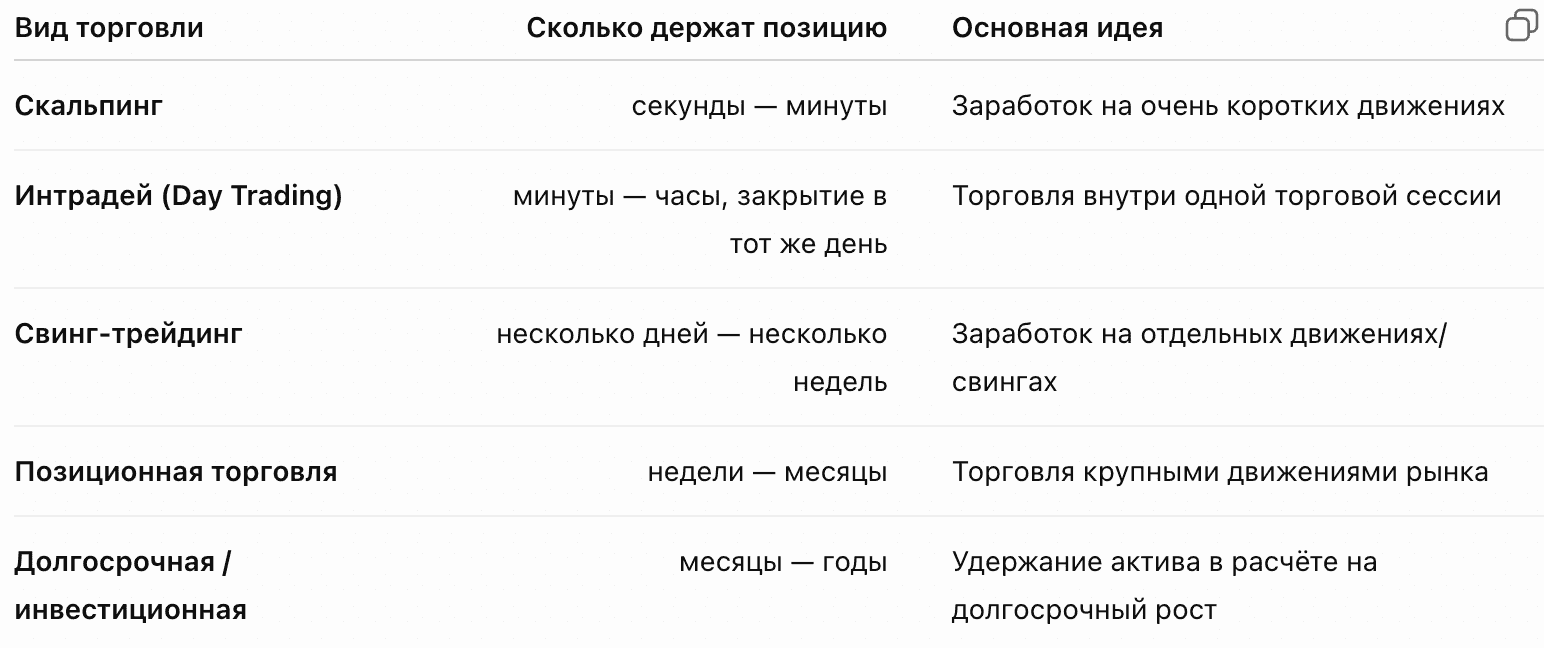
Depending on the time a trader remains in a position, trading can generally be divided into scalping, day trading, swing trading, position trading, and long-term investing.
Each approach differs not only in how long a trade remains open, but also in the type of market movement the trader is trying to capture.
⚡ Scalping
Scalping is the shortest-term type of trading. Positions can be held anywhere from a few seconds to several minutes.
The main idea is to profit from very small price movements. A scalper typically executes a large number of trades, with each trade targeting a relatively small change in price.
Speed and precise execution are especially important in this type of trading. Since trades develop very quickly, the trader needs to monitor the market closely and make decisions almost immediately.
Scalping is focused entirely on short-term price movements and is fundamentally different from trading approaches where positions can remain open for weeks or months.
📊 Day Trading
Day trading involves opening and closing a position within the same trading day.
A trade may last anywhere from a few minutes to several hours. The key characteristic is that the position is closed before the trading day ends and is not carried overnight.
A day trader analyzes price action during the current trading session and attempts to capitalize on market movements that develop throughout the day.
Compared with scalping, day trading allows more time for a trade to develop. However, the defining feature remains the same: the position is closed within a single trading day.
🔄 Swing Trading
Swing trading is designed to capture price movements that can last from several days to several weeks.
The goal is not to capture every small price fluctuation, but rather to participate in significant individual moves within the market.
This makes swing trading a middle ground between short-term trading and position trading.
A trader may analyze the overall market structure using higher timeframes while using lower timeframes to identify a specific entry point.
📈 Position Trading
Position trading involves holding a position for several weeks or even months.
The main idea is to capture a larger market move rather than profit from short-term price fluctuations.
With position trading, understanding the broader market structure becomes especially important. A trader needs to evaluate not only the current price, but also the direction of the market, major structural developments, and potential price targets.
At the same time, the actual entry can be identified on a relatively low timeframe. Therefore, using M5, M15, or H1 to find an entry does not automatically make a trading strategy scalping or day trading.
The key factor is the time horizon of the position itself.
For example, a trader may determine the market direction on a higher timeframe, identify an area of interest, and then wait for confirmation on a lower timeframe. Once the trade is opened, the position may be held for several weeks or months.
🏦 Long-Term Trading and Investing
The longest-term approach is long-term trading or investing.
In this case, a position may be held for several months or even several years. The main idea is to benefit from long-term appreciation in the value of an asset.
Unlike short-term trading, an investor does not necessarily need to react to every price movement. The primary focus is on longer-term market developments.
🎯 Which Trading Approach Should You Choose?
Trading can therefore be broadly classified according to how long a position is held:
Scalping - seconds to minutes. Day trading - minutes to hours, with the position closed the same day. Swing trading - several days to several weeks. Position trading - several weeks to several months. Long-term trading / investing - several months to several years.
It is important to understand that the timeframe used for analysis and the duration of the position are not the same thing.
A trader can use a lower timeframe to identify a precise entry while still being a position trader.
Ultimately, the choice of trading style determines what type of market movement you are trying to capture: a small short-term move, an individual swing, or a larger market move that can develop over weeks or months.