
When choosing a trading style, traders often ask themselves: which type of trading can generate more profit, and which one is more likely to lead to significant losses?
There is no definitive answer. Neither scalping, day trading, swing trading, nor position trading is inherently profitable or unprofitable.
Results depend on the quality of the trading system, risk management, market analysis, and the trader's discipline.
However, when different trading styles are evaluated based on the number of decisions required, market noise, and the likelihood of making mistakes, there are significant differences between them.
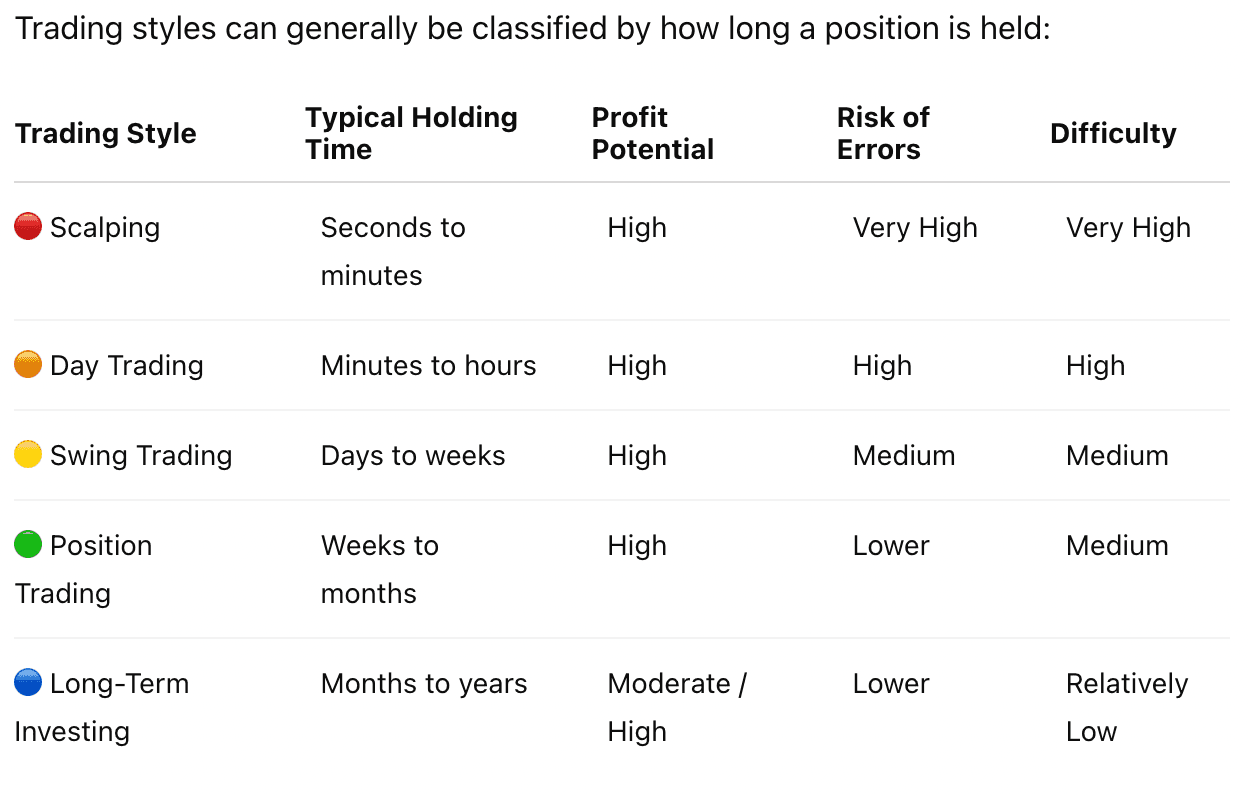
📊 Comparing the Main Trading Styles
This is not a ranking of guaranteed profitability. Instead, it reflects how much constant decision-making each style requires and how easily a trader can make a series of mistakes.
🔴 Why Can Scalping Often Lead to Major Losses?
Scalping may seem attractive because of its high trading frequency. A trader can execute dozens of trades during a single trading day.
However, this is also its biggest disadvantage.
If a trader makes 30-50 trades per day, just a few mistakes, emotional entries, or attempts to recover losses can significantly damage the overall result.
In addition, a large number of trades increases the impact of:
commissions; spreads; slippage; random market movements.
For this reason, scalping requires a very high level of discipline and a thoroughly tested trading system.
🟠 Day Trading: More Time, But the Problem Remains
Day trading gives a trader more time for a trade to develop than scalping. However, the trader still has to constantly monitor the market and make decisions throughout the trading day.
A particularly dangerous sequence can look like this:
overtrading → a series of losses → trying to recover losses → increasing risk → even larger losses.
Therefore, the high potential of day trading comes with a large number of trading decisions, which also creates more opportunities for mistakes.
🟡 Swing Trading: A Reasonable Balance
Swing trading allows traders to participate in more significant market movements.
A position may be held for several days or weeks. The trader does not need to react to every short-term price fluctuation.
Instead, the trader can wait for a meaningful price movement to develop, enter the position, and allow the market to follow the expected scenario.
At the same time, the number of trades is typically lower than with scalping or day trading.
This is why swing trading can be viewed as a balance between short-term trading and position trading.
🟢 Position Trading: Capturing Larger Market Moves
Position trading is particularly interesting for traders who use market structure analysis.
The goal is not to capture every price movement, but rather to identify a larger market scenario and participate in its development.
For example, the logic may look like this:
higher timeframe → market structure → accumulation → breakout from accumulation → confirmation → entry → development of the larger move.
In this case, the trader is trying to capture the overall move rather than every small price fluctuation within it.
If a significant move begins after a market structure has formed and continues for several weeks, intermediate corrections do not necessarily become a reason to close the position.
🎯 Why Can Position Trading Be More Interesting?
One of the main advantages of position trading is that the trader does not need to remain constantly focused on the market.
The trader can identify the direction of the market on a higher timeframe, wait for the necessary structure to form, and only then look for an entry.
Lower timeframes can still be used to find the entry point.
For example, the analysis can be performed on D1 or H4, the structure can be refined on H1, and the entry can be identified on M15 or M5.
Using M5 or M15 does not automatically make the strategy scalping. The determining factor is the length of time the position is held.
⚠️ Position Trading Does Not Eliminate the Risk of Losses
It is important not to create the false impression that position trading is automatically safer.
Incorrect market structure analysis, excessive leverage, an oversized position, or poor risk management can lead to significant losses regardless of the trading style.
Therefore, the key question is not only which trading style to choose, but also how well the trading system itself is designed.
🏆 Which Trading Style Should You Choose?
If we roughly rank the trading styles by complexity and the risk of making mistakes, the sequence would look like this:
Scalping 🔴 → Day Trading 🟠 → Swing Trading 🟡 → Position Trading 🟢 → Long-Term Investing 🔵
This does not mean that scalping is necessarily unprofitable or that position trading is necessarily profitable.
The main difference lies in the number of decisions, the level of market noise, and the opportunity for emotional mistakes.
For traders who use market structure analysis, position trading can be a particularly interesting approach.
First, the larger market move is identified. Then the market structure and area of interest are determined. Finally, a lower timeframe is used to identify the entry point.
Instead of trying to profit from every price movement, the trader focuses on capturing the most significant market move.