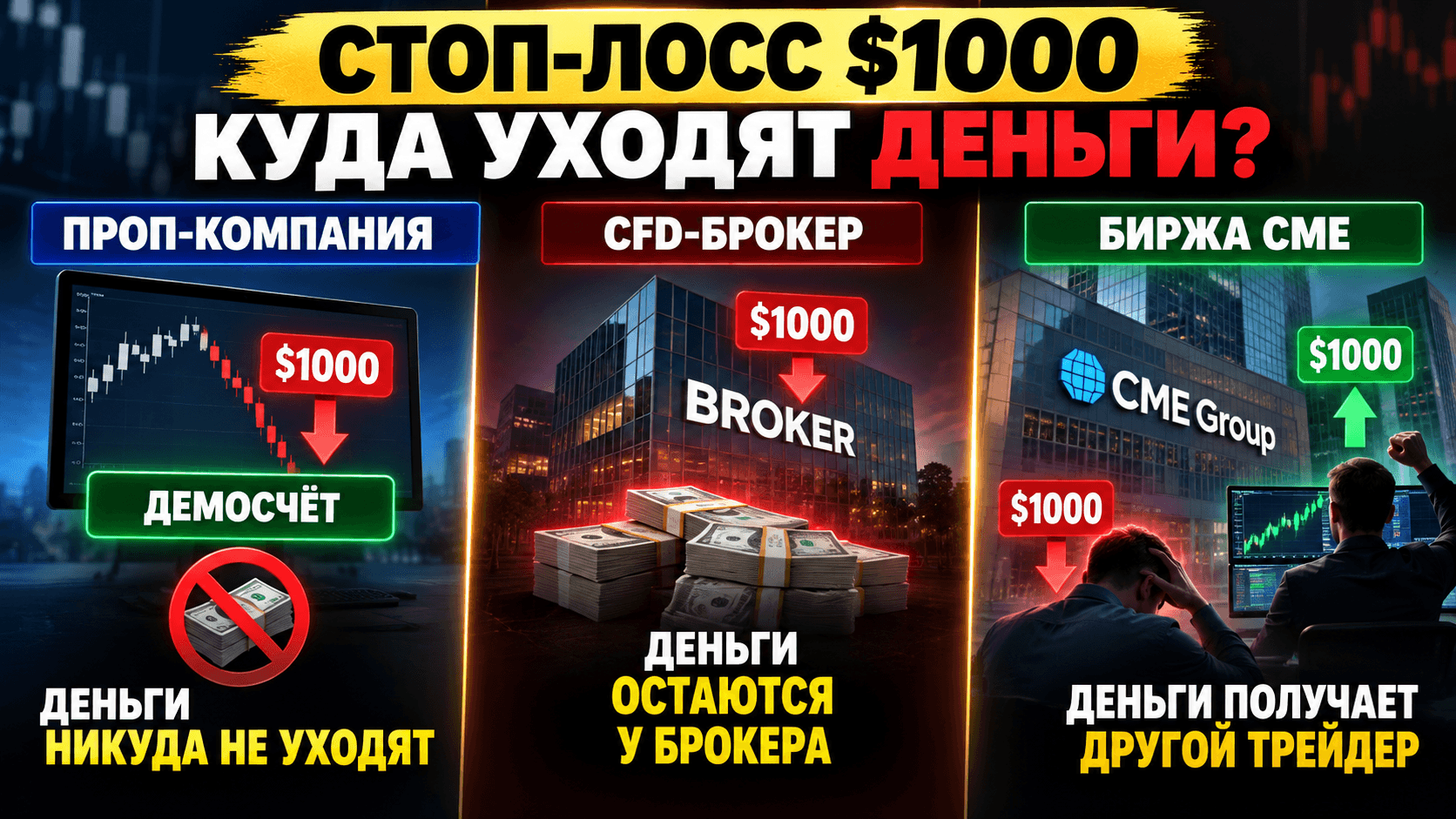
The question only sounds naive until your first big stop: where did my $1000 go? The answer depends not on your strategy or instrument, but on what structure sits behind the "buy" button.
Three different mechanisms under one button
Visually, the terminal looks the same everywhere: a chart, volume, stop, take-profit. But behind that identical interface there can be completely different things - a simulator with payout rules, a broker's internal book, or exchange clearing.
That's why the fate of your money after a stop differs. In one case, your money was never actually in the trade at all; in another, it moved to a specific counterparty; in a third, everything is decided by the platform's internal policy.
| Platform | What happens to the trade | Where the loss is reflected |
|---|---|---|
| Prop firm | Usually a demo account | Virtual, payouts follow company rules |
| CFD broker | Inside the broker or hedged on the external market | On your account, with the broker - depends on the situation |
| CME exchange | Real futures contract | On your account, with the counterparty gaining |
Prop firm: virtual loss, real rules
At most prop firms, trading runs on a demo account. That means when the stop triggers, nothing actually moves anywhere - a number simply changes in the accounting system.
What stays real are the rules: how much of the profit you get, at what drawdown the account gets closed, which trades count as a violation. For me, that's the main thing to read before paying for a challenge, not something to dig for in support later.
Common questions about prop firms and CFDs
If a prop firm uses a demo account, where do the payouts come from?
From the company's own money, under its distribution rules - which is why payout terms matter more than the type of trading terminal.
Does a loss at a CFD broker mean the broker made money?
Not necessarily: if the position is hedged on the external market, the broker's result is determined by that hedge, not by your stop.
What does it mean when a "trade stays inside the broker"?
It means the broker doesn't pass the position on externally but keeps it on its own books, acting as the counterparty to the contract.
Exchange: every position has a counterparty
On CME, a futures contract is a real contract with specific terms. If you're in the red, someone was holding the opposite position, and their result on that trade is the mirror opposite.
The exchange itself isn't your counterparty, though. It keeps records, calculates margin, and guarantees settlement through clearing, earning its money from fees - not from you hitting a stop.
Common questions about exchanges and execution
Does the exchange profit from my stop?
No, the exchange's income comes from fees and services, not from any individual participant's result.
How can I tell where my order actually goes?
Check the platform's documents for execution type and regulation: exchange access and internal execution are described differently.
Why does this matter if the strategy is the same either way?
The setup determines spread, slippage, withdrawal terms, and who you raise a dispute with if something goes wrong.
What to check before putting money on the line
My minimum checklist: who is my counterparty, where is the position recorded, what rules determine how the result is calculated and paid out, and who is the regulator. Four points that take an evening of reading and save months of headaches.
On which platform does your trading loss mean a positive result for the counterparty?