
Many traders try to predict where the market will move in the next minute, hour, or day. As a result, decisions are often driven by emotions, and trades are opened only after the main move has already taken place.
In reality, the market works differently. If you understand the patterns behind price movement and have even a basic understanding of trading psychology, you can accurately assess the current market situation before it fully unfolds.
🔍 What This Example Shows
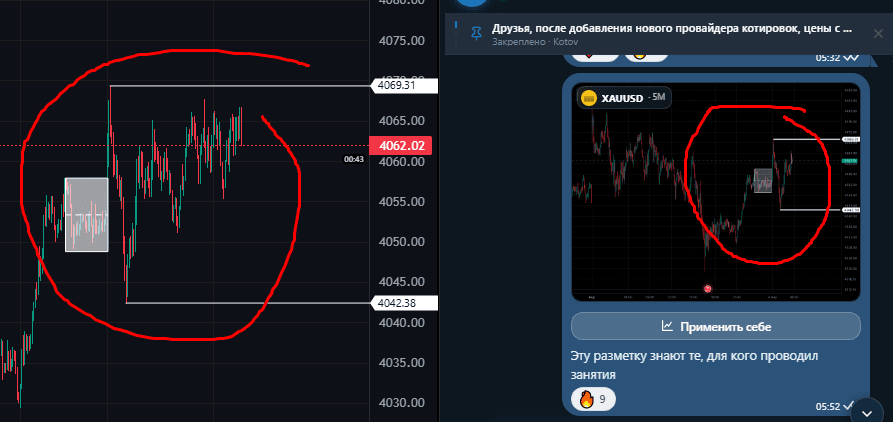
The image on the left shows the current market situation. The image on the right shows the market markup that was published in advance.
The most important part is not the fact that the scenario matched. What really matters is that the price has followed the expected path almost exactly as anticipated before the move developed.
This is not luck or a fortunate guess. It is the result of analyzing the market based on its underlying logic rather than trying to predict every price movement.
📊 Why Price Behaves This Way
Every price movement is created by the actions of market participants. Some traders are opening positions, others are taking profits, while some are closing losing trades.
When you understand where positions are being accumulated and recognize the interests of larger market participants, it becomes much easier to interpret what is happening on the chart.
That is why many price movements that seem unexpected to most traders are actually a natural continuation of the market structure that has already been forming.
Of course, the market is never obligated to follow a scenario with perfect precision. However, understanding its logic allows you to identify the most likely outcome in advance and prepare for it instead of reacting emotionally.
🎯 Why Most Traders Get It Wrong
One of the biggest mistakes traders make is focusing only on the final result.
They see a completed price move and then try to explain why it happened. In reality, it is far more valuable to understand the conditions that led the market to that outcome in the first place.
Once you shift your attention from trying to make perfect predictions to studying price behavior, your entire perspective on the market begins to change.
Instead of constantly guessing the next direction, you start recognizing why price is building a particular structure and which scenarios have the highest probability of playing out.
💡 The Key Takeaway
I have always followed one simple principle: don't try to predict the market - understand the logic behind its movement.
This approach allows you to recognize opportunities before most market participants notice them. Over time, success becomes less about intuition or luck and more about consistent analysis, understanding price behavior, and recognizing recurring market patterns.