
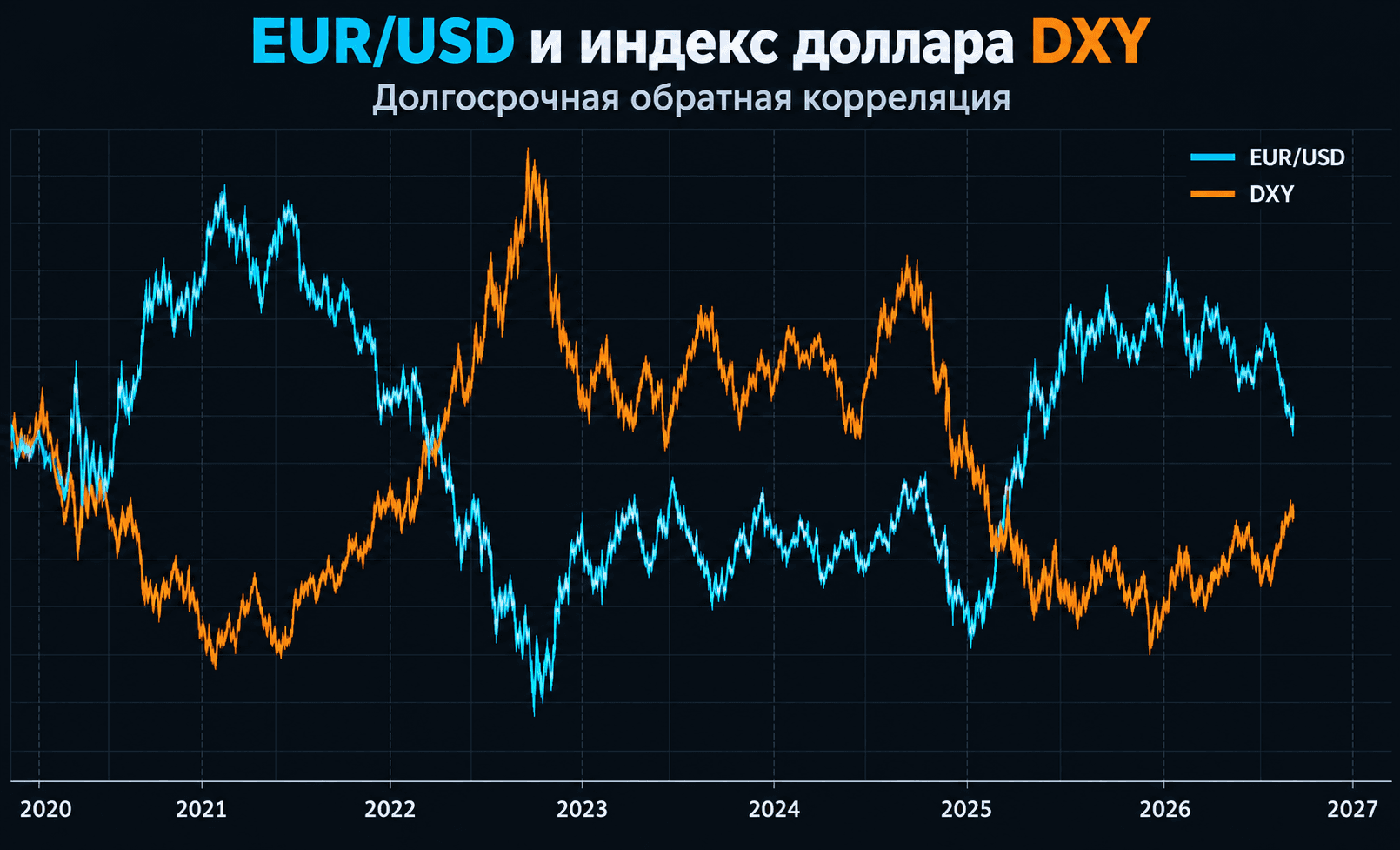
When the dollar index rises, EUR/USD usually falls. When DXY weakens, the pair gets support. Over longer stretches of the chart this is visible without any calculations at all: just put the two instruments side by side and compare directions.
Where the inverse relationship comes from
The dollar index is calculated against a basket of currencies, and the euro holds the largest share in that basket. That makes DXY, to a significant degree, an inverted EUR/USD: the same dollar move simply recorded in two different ways.
So the mirroring isn't a coincidence or a statistical quirk. It's a property built into the index's construction, and it can't fully break down - it can only weaken when the other currencies in the basket start pulling the index their own way.
For me, the practical point is that DXY shows the dollar in a broader context than a single pair can. If the dollar is strengthening all at once against the euro, yen, and pound, that's a different picture than if it's only rising against the euro for internal European reasons.
Why do EUR/USD and DXY move in opposite directions?
The euro carries the heaviest weight in the dollar index basket, so the dollar strengthening against the euro almost directly pushes DXY up and the pair down.
Can you trade EUR/USD without looking at DXY at all?
You can, but then you lose the full picture of the dollar and can't tell whether a move is coming from the dollar or from the euro.
Are DXY and EUR/USD basically the same chart?
No, the index is calculated against several currencies, so its movement only partially matches the inverted pair.
Where the correlation breaks down
The inverse relationship doesn't mean the two charts are always a perfect mirror of each other. The strength of the link drifts: there are weeks when the match is almost exact, and stretches where the instruments diverge.
Most often the divergence comes from the euro's side. Internal European stories move EUR/USD but barely register on the other pairs in the basket, so the index stays put while the pair moves.
The reverse happens too: a sharp move in the yen or the pound pushes DXY while EUR/USD stands still. These episodes are actually useful - they show that the source of the move isn't the dollar.
How stable is the inverse correlation?
The direction of the link is stable over longer stretches, but its strength changes, and over shorter stretches the charts can diverge.
What does it mean if EUR/USD rises but DXY doesn't fall?
It usually signals that the move is coming from the euro, not from broad dollar weakness.
On which timeframe is the link clearest?
The larger the scale, the cleaner the picture: on daily and weekly charts the mirroring is visible without any measurements.
How I fold DXY into my work
I keep DXY nearby as background context. If a bearish scenario is shaping up on EUR/USD while the dollar index is turning upward off its own structure, that adds weight to the scenario.
If DXY runs against my idea on the pair, I don't scrap it automatically, but I wait for clearer confirmation on EUR/USD itself. Diverging signals are a reason to slow down, not a reason to flip the idea.
I still look for levels on the instrument I actually trade. DXY answers the question "what's going on with the dollar overall," while the entry point and the level where the idea stops working come from the pair's own chart.
What usually happens to EUR/USD when the DXY dollar index rises?