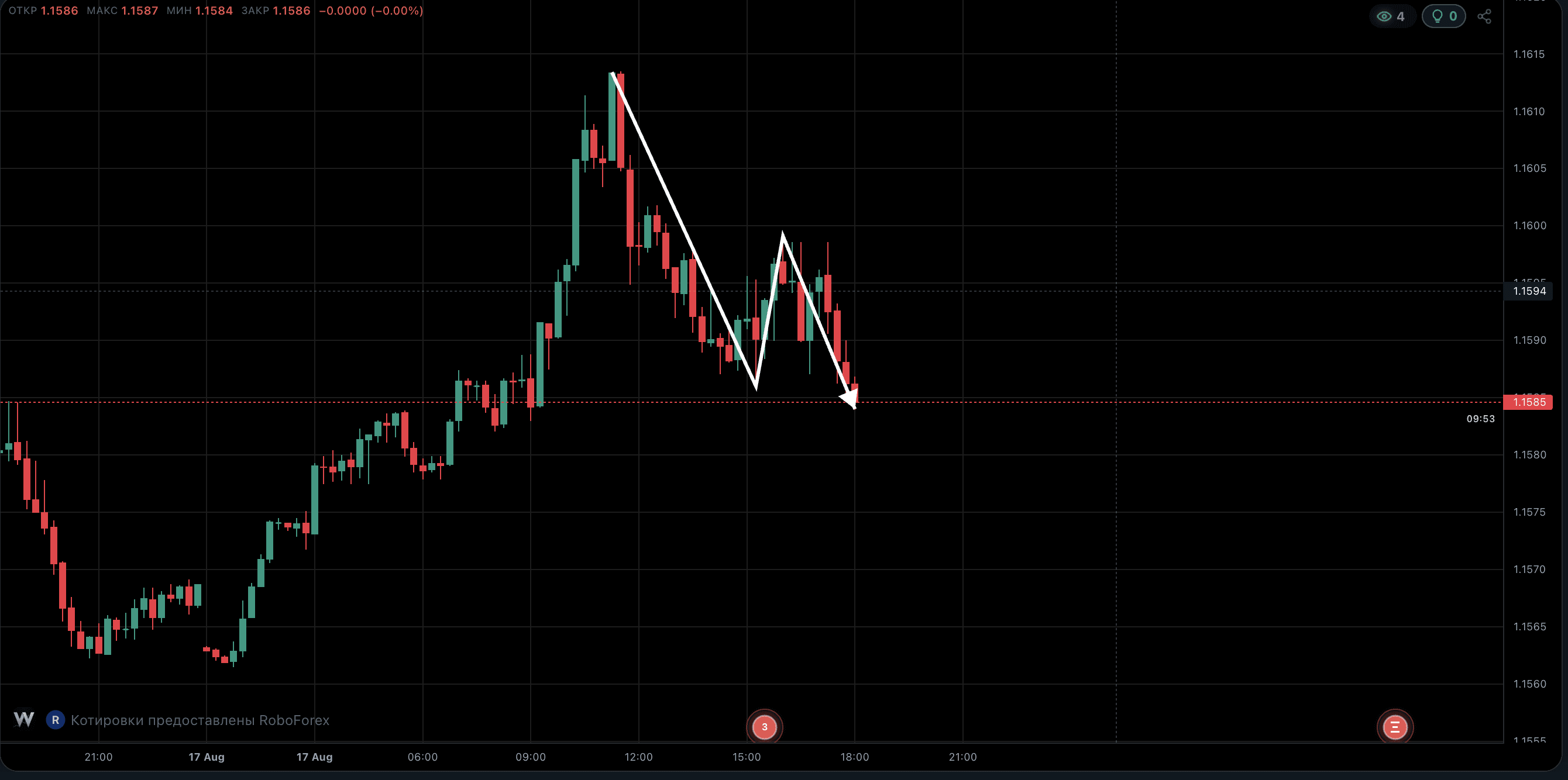
The word "trend" gets slapped on almost any rally or drop, and that's where the confusion starts, right at the most basic level. On the chart the difference is visible with the naked eye, no indicators needed: you just have to tell a simple move apart from a complex one.
Simple move
A simple move is when price goes in one direction and there's no significant secondary move inside that run. It has a start and an end, and in between price never reverses by any meaningful amount.
I don't count tiny wicks or one-bar pullbacks as simple moves: they don't change the picture and don't split the run into parts. The moment a separate, self-contained leg against the direction shows up inside it, that's no longer one simple move - it's two simple moves plus a counter-move between them.
A simple move by itself says nothing about a trend. Price can travel a good distance upward and just stop there: one move up is one move up, and nothing more.
Trend move as a complex structure
A trend move is complex - it's made up of simple moves. The minimum required count is three: two in the same direction and one in the opposite direction between them.
So price moves up, pulls back in a separate, self-contained move, then moves up again. That's the point where I can say I have my first trend move. Before that third leg appears, there's nothing to call a trend: I've either got one run, or a run plus a pullback.
The logic here is simple. One run shows that price got pushed somewhere. A run plus a pullback shows that it got pushed and then let go. And only a third leg in the direction of the first shows that after the counter-move, price came back to the original direction - and that's a structure now, not a one-off spike.
How to count moves on a chart
The first thing I do is pick a timeframe and stick to it for the rest of the analysis. You can't mix timeframes: finding two moves on the hourly and a third on the 5-minute throws the count off, and any conclusion about a trend won't hold up.
Next, I mark out the price run into segments: where a move starts, where it ends, where the counter-move begins. Each move needs to read as distinct - with a clear start and end - not as noise inside a bigger run.
Once there are three such segments and they line up as "two in one direction, one against it," there's a trend move. If there are only two segments, I wait. If the counter-move ends up big enough to erase the entire first run, the whole structure needs to be rebuilt from scratch - the direction has already changed.
Frequently asked questions
How is a trend move different from a simple move?
A simple move runs in one direction with no significant counter-moves, while a trend move is complex and made up of at least three simple moves.
How many moves do you need before you can call it a trend?
At least three: two in the same direction and one in the opposite direction between them.
Does one strong move up count as a trend?
No, that's just one simple move. Until a pullback and a repeat move in the same direction show up, there's no trend structure.
Is a small pullback inside a run already a separate move?
No, not unless it reads as a self-contained segment with its own start and end. Pullbacks like that don't split the run into parts.
Which timeframe should I use to count moves?
One timeframe, chosen in advance. A single simple move on a higher timeframe will break down into several simple moves on a lower one, so you can't mix them.
What's the minimum set of moves that makes up the first trend move?