
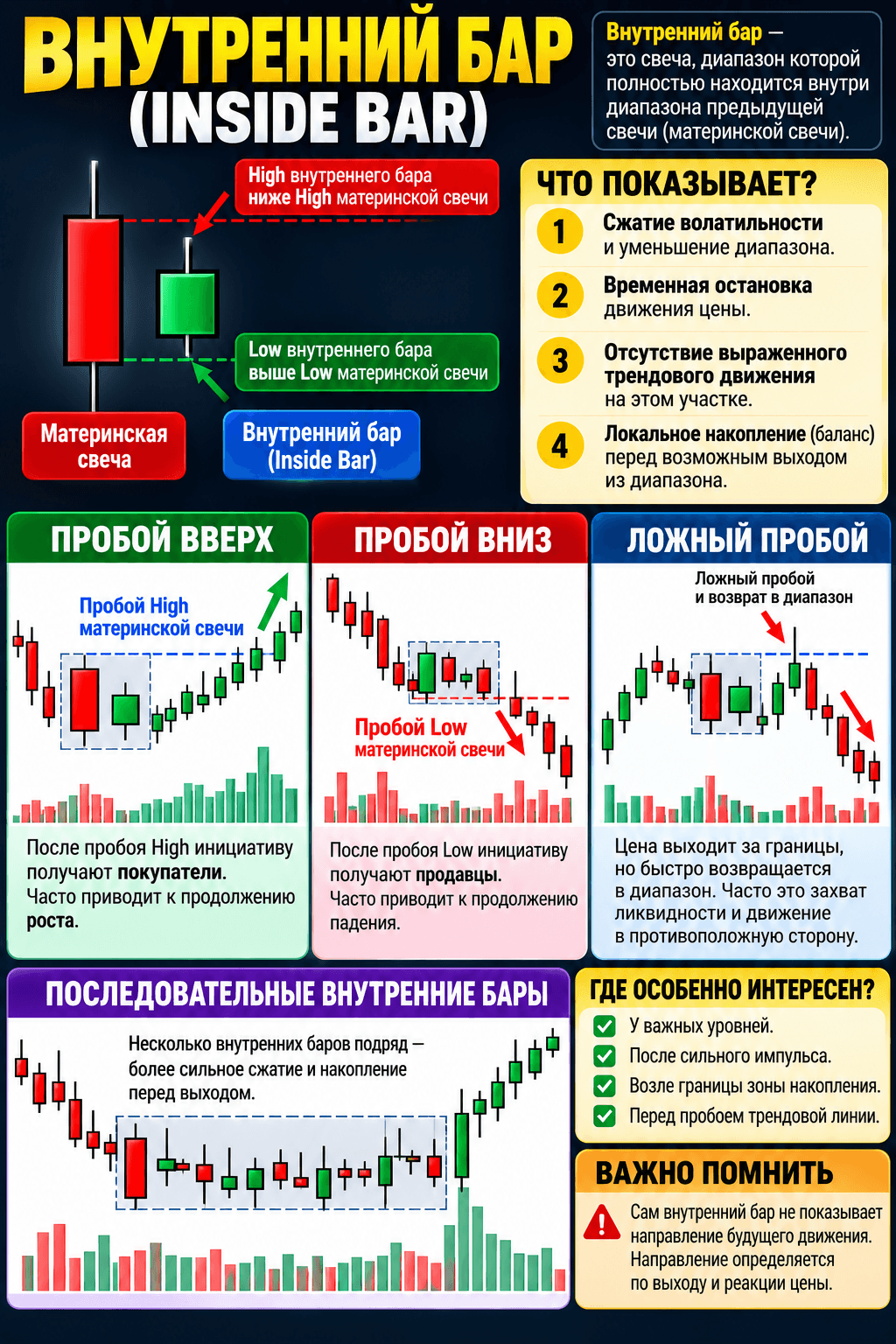
Inside Bar is one of those patterns everyone sees but interprets differently. To me it's primarily a fact of compression: the candle's range fits entirely inside the previous one, and neither side managed to push price beyond the boundaries of the prior bar. There's no directional movement within this segment, just holding.
What range compression shows
When a new bar doesn't update either the high or the low of the previous one, the market hasn't picked a side during that stretch. Buyers haven't pushed up, sellers haven't pushed down, trades are happening within an already-established corridor. This is a local balance of participants.
Balance itself is neutral. It doesn't tell you who's building a position and where the eventual breakout will go - it simply records that, at the current scale, neither side had enough pressure. That's why I treat Inside Bar as a market state, not as a signal.
What is Inside Bar in simple terms?
A candle whose high and low both fall within the range of the previous candle.
Is Inside Bar a buy or sell signal?
Neither: on its own it only shows range compression and the absence of a chosen direction.
What timeframe should I watch Inside Bar on?
Whichever one you use to find levels and make decisions, because on lower timeframes compression shows up constantly.
Why not every Inside Bar is accumulation
This is where the main mistake happens. Inside Bar does show compression and lack of pronounced movement, and it can be viewed as local accumulation or balance. But I wouldn't automatically equate the two.
Accumulation implies that someone is building a position within the range, and that buildup later turns into movement. Compression, on the other hand, can also happen simply from a lack of interest: a thin market, a pause between sessions, a lull before data releases. Visually the picture is the same, but the meaning is different.
So I don't look at an individual candle in isolation - I look at where it appeared and what came before it. An Inside Bar in the middle of a sluggish range and an Inside Bar right after a strong impulse are two different situations, even though the pattern is formally identical.
How does accumulation differ from ordinary compression?
Accumulation leads to a breakout into directional movement, while ordinary compression more often ends with a return into the same corridor.
Can any Inside Bar be considered an accumulation zone?
No, the pattern only shows balance, and it becomes accumulation in the context of a preceding impulse.
Does what happened before Inside Bar matter?
Yes, the preceding impulse is exactly what separates a meaningful pause from simple quiet.
The sequence I use to read the pattern
The logic looks like this: impulse, then range compression, then balance of participants, then a breakout from the range, and then new directional movement. Every step has its place here, and you can't skip the first one.
The impulse creates room to run and sets the boundaries within which trading then takes place. Compression shows that movement has stopped, but not reversed. Balance is the stage where both sides are operating within the same corridor. And only a breakout beyond the boundaries of that corridor turns the situation into new movement.
Until the breakout happens, I don't have a direction, I have boundaries. The high and low of the mother bar form the working frame against which I assess whether a breakout has occurred or price has stayed inside.
Frequently asked questions
Where are the boundaries of the range for an Inside Bar?
The high and low of the previous, mother candle, inside which the inner bar fits.
What counts as a breakout from the range?
A candle closing beyond the boundary of the mother bar, not just a wick touching it.
What invalidates the idea of a breakout?
Price returning back inside the range after breaking the boundary: the balance hasn't resolved, the pattern continues.
How many Inside Bars in a row can there be?
As many as you like, and several in a row indicate that compression is intensifying and the decision frame is narrowing.
What absolutely must precede an Inside Bar for it to be considered accumulation?