
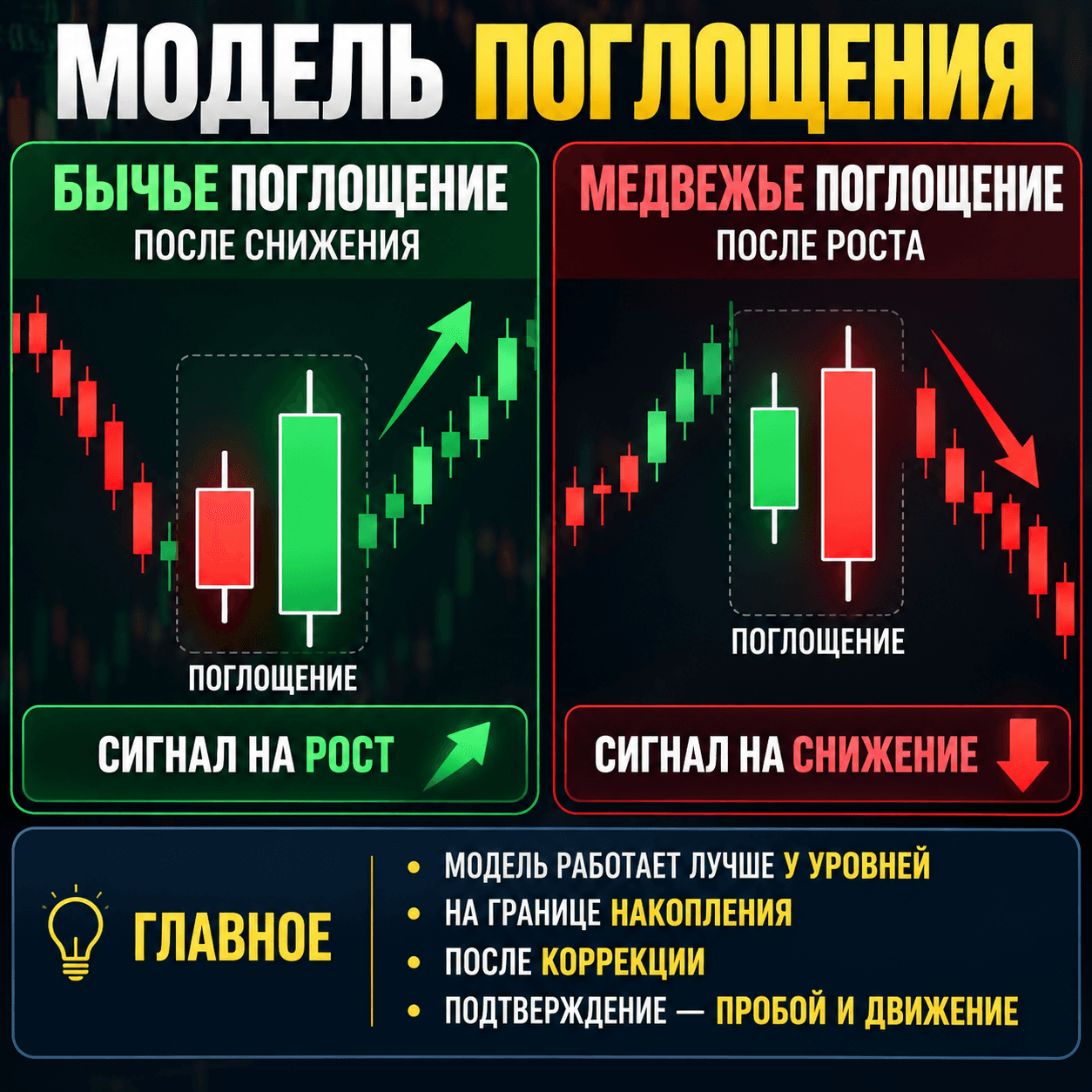
Engulfing is one of the most straightforward candlestick patterns. It directly shows that the short-term balance between buyers and sellers has shifted: one side has wiped out everything the other did on the previous candle.
What bullish and bearish engulfing look like
Bullish engulfing forms after a decline. First comes a bearish candle, then a strong bullish one whose body covers the previous candle's body. All the selling pressure from that stretch gets overridden by a single upward move.
Bearish engulfing is the mirror image. After a rally, a strong bearish candle appears that fully covers the previous bullish candle's body. The initiative on that short stretch shifts to the sellers.
I focus specifically on candle bodies. Wicks add extra context about where price was rejected, but the base condition of the pattern is body overlap, not overlap of the extremes.
Common questions about the pattern's shape
How does bullish engulfing differ from bearish engulfing?
Bullish forms after a decline and covers a bearish candle to the upside, bearish forms after a rally and covers a bullish candle to the downside.
Does the candle need to cover the previous wicks too?
The base condition is body overlap with the previous candle, covered wicks make the picture stronger but aren't a required feature.
Does engulfing need a prior trend?
Yes, the pattern reads as a shift in balance, and there's nothing to shift if there was no prior move: bullish engulfing is preceded by a decline, bearish engulfing by a rally.
Why the pattern alone isn't a reason to enter
Engulfing shows up on the chart constantly, on any timeframe and in any market phase. In the middle of a range, in a sluggish sideways move, inside chaotic price action it says almost nothing: two candles simply overlapped.
I treat the pattern as a hint about a shift in short-term balance, not as a signal. Context is what turns it into a signal, and without context there's little point looking at it.
Where engulfing starts to matter
It gets far more interesting when the pattern forms at a strong level, at the edge of accumulation, or after a correction. Then it shows that one side is starting to seize the initiative exactly where it matters.
For me, the working combination looks like this: engulfing plus level plus breakout. The pattern gives the first hint, the level explains why the move happened here, and the breakout confirms that the shift in initiative wasn't a one-off spike.
Common questions about trading the pattern
Can I enter right after the engulfing candle closes?
The pattern alone isn't an entry: I look at where it formed and wait for confirmation through movement from a level or a breakout.
On which timeframe is engulfing more reliable?
The pattern reads on any timeframe, but the higher it is, the more participants have seen this shift in balance, so lower timeframes produce more random triggers.
What makes engulfing significant?
The location where it forms: a strong level, the edge of accumulation, or the end of a correction - not the shape of the candles themselves.
What invalidates the idea behind the pattern?
Price returning inside the engulfing candle's body and continuing in the original direction: the balance shift never actually happened.
What turns engulfing from just two candles into an interesting trading situation?